


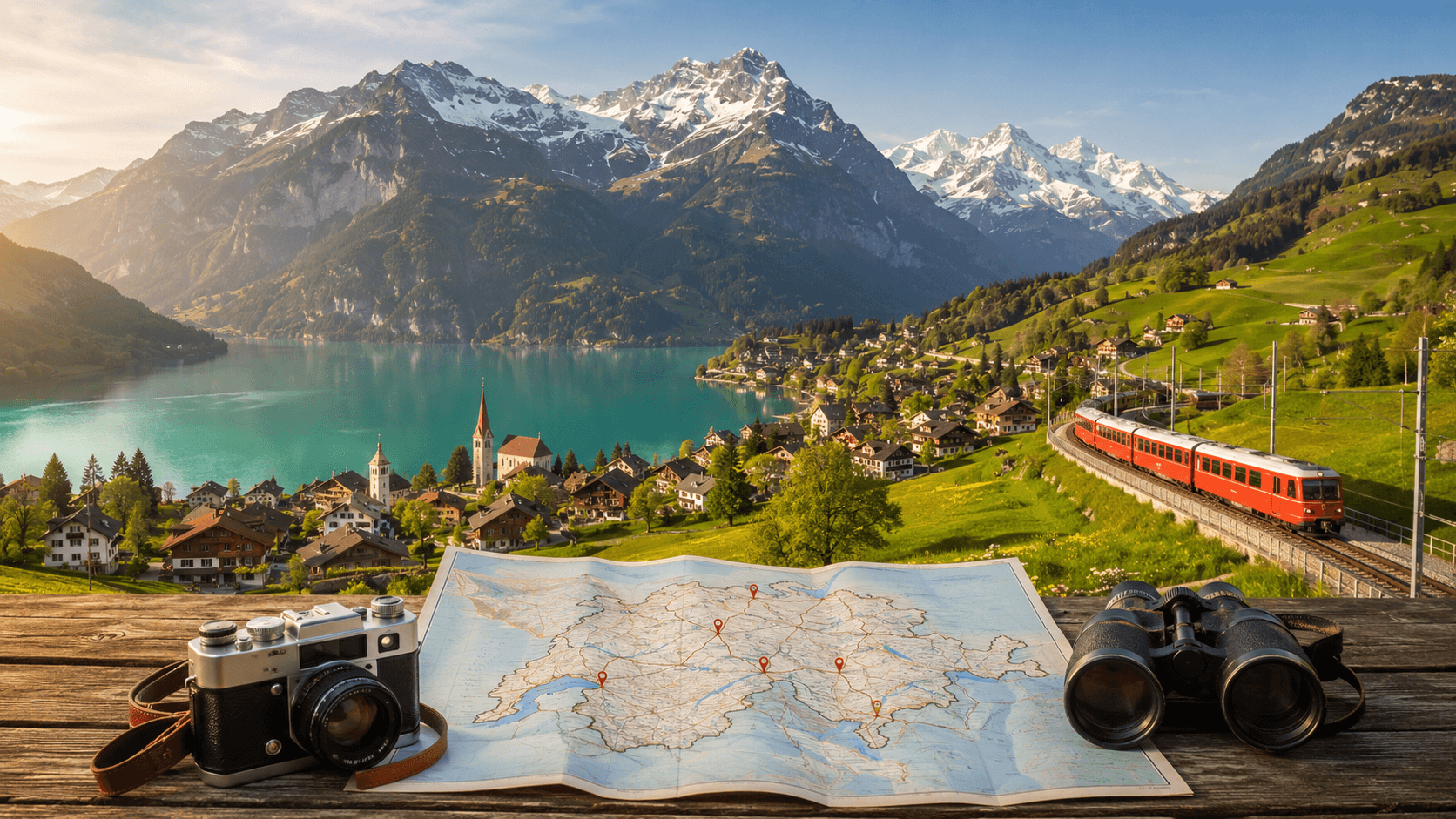
 Switzerland Interactive Map
Switzerland runs a remarkably smooth public transport web. Over five thousand kilometers of steel rails link bustling cities to isolated snowcapped peaks. Getting around this mountainous terrain goes smoother with a solid plan that highlights the Top Destinations & Must-See Attractions to get the most out of your days.
Mapping Your Swiss Travel Route
Piecing together a smart Swiss loop requires a basic grasp of the local geography. Trains run with clockwork accuracy, arriving and departing in perfect harmony across every station. When plotting these Top Destinations & Must-See Attractions, separating the country into geographic regions helps prevent wasted transit hours.
Structuring your path around main rail stations like Zurich, Bern, and Geneva saves massive amounts of transit time. Grouping your targets by region lets you watch the local culture shift naturally. In the central territory, you hear German spoken in ancient towns, while the west eases into French-speaking terraced vineyards.
| Region | Main Hub | Key Highlights |
|---|---|---|
| Central Switzerland | Lucerne | Chapel Bridge, Mount Pilatus, Mount Rigi |
| Bernese Oberland | Interlaken | Jungfraujoch, Lauterbrunnen Valley, Schilthorn |
| Valais | Zermatt | The Matterhorn, Gornergrat Railway, Thermal Baths |
| Lake Geneva Region | Geneva / Lausanne | Chillon Castle, Lavaux Vineyards, Montreux |
| Graubünden | St. Moritz | Swiss National Park, Bernina Express, Landwasser Viaduct |
Central Switzerland and the Historic Heart of Lucerne
Lucerne rests right on the shores of its namesake lake, making it a perfect springboard for a classic Swiss tour. Here you will find the Chapel Bridge, a historic wooden walkway built in 1333 over the rushing Reuss River. Excursionists can board old-fashioned cogwheel trains right outside town to climb into the clouds.
Lucerne remains highly popular because it blends medieval timber buildings with sweeping lakeside vistas. This makes the city one of the Top Destinations & Must-See Attractions for first-time visitors. Nearby, Mount Pilatus towers over the skyline, reached by a cogwheel train that climbs a staggering forty-eight percent slope, while Mount Rigi offers gentler paths and views across thirteen lakes.
This central region packed several historic spots and scenic rail paths close together. Travelers should look out for these specific spots when planning this leg of the journey.
- The medieval Chapel Bridge and its iconic stone water tower in the historic center.
- The Lion Monument, a moving sculpture carved into a solid rock face back in 1821.
- The Swiss Museum of Transport, featuring a vast display of vintage trains, boats, and flying machines.
The High Peaks of the Bernese Oberland
For dramatic mountain scenery, few places in Europe match the Bernese Oberland. Interlaken sits snugly between two lakes, Thun and Brienz, serving as the main transit gateway for the valleys. From its platforms, wooden train cars climb slowly into the Lauterbrunnen Valley, a deep gorge flanked by seventy-two roaring waterfalls.
Thrill-seekers head straight for this mountain landscape, using Interlaken to reach Top Destinations & Must-See Attractions such as the Jungfraujoch. This train terminal stands at a staggering elevation of 3,454 meters, earning it the title of the highest railway station on the continent. Up here, you can step directly onto the cold blue ice of the Aletsch Glacier, which stretches for twenty-three kilometers.
Summer brings endless dirt hiking paths, while winter blankets the area in exceptional ski runs. Keeping a close eye on the local weather forecast pays off when planning high-altitude visits. Make sure to mark these specific landmarks on your personal itinerary.
- The quiet, car-free village of Wengen, which can only be reached by rail.
- The high peak of the Schilthorn, where a rotating restaurant sits at 2,970 meters.
- The Staubbach Falls, sending water plunging almost 300 meters straight down a sheer rock wall.
Valais and the Iconic Matterhorn
The canton of Valais occupies the southwestern corner of the country, surrounded by giant peaks. Zermatt remains the shining star of this territory, nestled right at the foot of the jagged Matterhorn. The mountain village bans gas-powered cars to keep the air crisp and the streets quiet.
Zermatt draws mountain climbers and skiers throughout the year, keeping it firmly on the list of Top Destinations & Must-See Attractions in the southwest. Since 1898, the cogwheel trains of the Gornergrat Railway have hauled passengers to an observation deck at 3,089 meters. Standing there, you can count twenty-nine different peaks that rise past the four-thousand-meter mark.
Hikers seeking thrills can head to the high suspension bridges spanning the glacier valleys. Afterward, hot spring resorts like Leukerbad offer a warm soak to soothe tired muscles. This region connects smoothly with the slow-moving Glacier Express train, allowing a direct link over to eastern ski towns.
Cultural Treasures of the Lake Geneva Region
Heading west brings you into French-speaking Switzerland, where the culture shifts toward lakeside strolls and terraced hillsides. Geneva and Lausanne serve as the main city hubs, home to massive museums and global organizations. The shores of the massive lake enjoy an unusually soft microclimate where palm trees and southern flowers thrive.
Wandering through this western side reveals historical treasures right on the water, including Top Destinations & Must-See Attractions like Chillon Castle. This stone fortress sits on a rocky islet near Veytaux, with roots stretching back to the eleventh century. Just up the shore, the Lavaux wine region covers eight hundred hectares of ancient, steep terraces recognized by UNESCO.
Vintage paddle steamers still ply these waters, carrying travelers between Swiss towns and French ports. Every July, Montreux hosts its legendary jazz festival, bringing crowds of music lovers to the lakefront. It is an area that blends dramatic scenery with a relaxed, artistic lifestyle.
The Scenic Wonders of Eastern Switzerland and Graubünden
Graubünden stands as the largest and most easterly territory in the country, known for rugged peaks and old Romansh traditions. St. Moritz sits here as the birthplace of luxury winter sports, having welcomed the Winter Olympics twice.
The canton is defined by its deep, shadowy valleys and high mountain passes.
Those who venture east will discover the high Engadin Valley, home to historic alpine resorts favored by luxury seekers. The red train cars of the Bernina Express climb right through these mountains, peaking at 2,253 meters at the Ospizio Bernina stop. The rail line itself is a feat of mountain construction, crossing fifty-five tunnels and nearly two hundred bridges.
Inside the same valley, the Swiss National Park protects over one hundred and seventy square kilometers of untouched wilderness. Hikers can explore eighty kilometers of wilderness paths to spot wild ibex, chamois, and soaring golden eagles. These eastern coordinates are well worth adding to your travel route.
- The quiet hamlet of Guarda, celebrated for its beautifully painted stone homes.
- The Landwasser Viaduct, a curving railway bridge that stands sixty-five meters tall over a forested ravine.
- The mineral-rich hot springs of Bad Ragaz, located close to the deep Tamina Gorge.
Useful Tips for Swiss Travel Mapping
Getting the absolute most out of your Swiss tour requires careful transit mapping and a clear budget. The Swiss Travel Pass offers unlimited rides for a set number of days across the entire national transportation grid. By organizing your path around these Top Destinations & Must-See Attractions, you get full value from the pass, which covers trains, buses, lake boats, and local streetcars in ninety cities.
You can ship your heavy bags ahead from station to station via the railway carrier’s baggage service. This lets you trek over mountain passes without dragging a heavy suitcase behind you. Keep the official SBB train app on your phone to check live platform changes and how crowded each carriage is.
Conclusion
Mapping out a Swiss holiday pays off when you organize your path by physical regions. This geographical grouping helps you hit all the Top Destinations & Must-See Attractions without losing half your day on train platforms. A well-thought-out map turns a complicated mountain tour into a smooth and unforgettable ride.


Comments are closed